What it costs, and what moves the number
Two different commercial models sit behind everything on this site. One is a subscription with payment processing costs passed through. The other is a written quotation against a defined scope. This page explains both, and what makes a number go up.

Two commercial models, not two versions of one
Operators ask for "your rates" as if there were one answer. There are two, and the difference is not a discount level.
| Platform product | Custom build | |
|---|---|---|
| What you buy | A licence to run on software we keep developing | A defined system built for your process |
| How it is charged | Subscription, per period, by scale of use | Fixed quotation for a written scope |
| Payment processing | Gateway and card costs passed through at cost | Same, and quoted separately from build work |
| Per booking | No percentage of each booking | Not applicable |
| Who owns it | We do, you licence it | You do, repository handed over |
| After launch | Included in the subscription | Optional maintenance agreement, or handover |
The line that surprises people most is the fourth one. izBooking takes no cut of any booking. A subscription plus what the gateway charges is the whole platform bill.
That is commercial, not generous. A per-booking percentage means your supplier earns more every time you sell more, and it taxes the direct channel you built precisely to escape marketplace commission.
Why there is no price list on this page
The phrase "a booking engine on our website" has covered a three-week job and a five-month one in the same month. A published figure would be wrong for one of those clients and bait for the other. What we publish is the arithmetic and the ranges; a written quotation turns them into a number before any work starts.
- Estimated build effort — weeks of work, and how many people at once.
- Third-party costs — gateway, hosting, domains, licences, translation. Passed through at cost, listed separately, never marked up quietly.
- A named contingency — not a percentage sprinkled on the total, but an amount attached to one risk we can point at, such as a bank approval.
- The out-of-scope list, which costs nothing today and is why the number holds tomorrow.
Everything is quoted against a written scope. If the scope changes, the number changes, in writing, before the work happens — not in an invoice at the end.
Indicative ranges by type of work
Bands, not prices. Band A is one person for a few weeks. Band B is a small team for one to two months. Band C is several people across a quarter or more. The quotation converts a band into a figure.
| Type of work | Typical first phase | Band | What moves it |
|---|---|---|---|
| Booking engine connected to an existing site | 3 - 5 weeks | A | How editable the current site is at template level |
| New operator or DMC website | 4 - 8 weeks | A to B | Page count, languages, whether content exists |
| Payment gateway live | 4 - 10 weeks | A to B | Bank and gateway approval, not code |
| Bokun or channel manager integration | 2 - 6 weeks | A to B | How clean the catalogue is on both sides |
| Data or partner API | 2 - 6 weeks | A to B | Quality of the source data |
| Mobile app, first release | 8 - 14 weeks | B to C | Offline behaviour and app store review |
| Digital transformation programme | One quarter and up | C | How many people have to change how they work |
Time and cost do not move proportionally. A gateway can take ten weeks and cost less than a five-week website, because eight of those weeks are a reviewer at a bank.
What actually moves a number
| Moves it up | Moves it down |
|---|---|
| Content and photography do not exist yet | You have final text and images before the build starts |
| Two or more languages, with the second one arriving late | One language at launch, second added as a defined later phase |
| Data has to move out of a system with no usable export | Old data small enough to enter by hand, or left behind |
| Nobody internally can decide pricing and cancellation rules | The commercial rules are already written down |
| A hard external date — a fair, a season, a campaign | A launch window rather than a launch day |
| Design invented from nothing | An existing brand with usable assets |
| Several approvers with different opinions | One named decision maker |
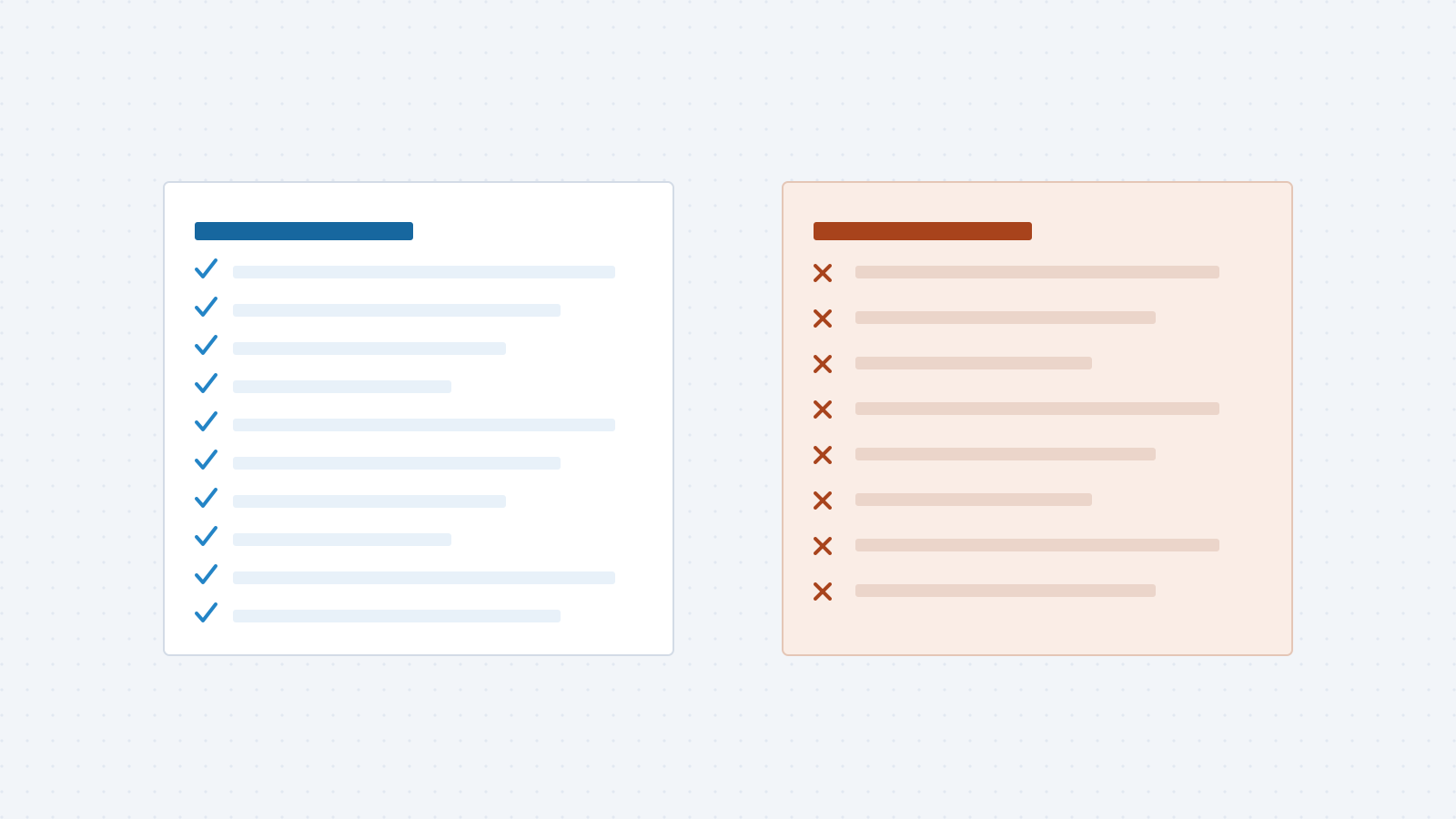
Read that as a shopping list, not a warning. Most of the left column can be moved right by the client, for free, before a quotation is asked for.
The costs clients forget to budget
A build quotation is not the cost of a working system. These are the items discovered after the invoice is approved, and none of them is small.
| Item | Who normally pays | When it hits |
|---|---|---|
| Written content, in every language you sell in | Client, or quoted separately | Before build; late content delays launch |
| Photography and video of your own product | Client | Before launch |
| Gateway fees and currency spread | Client, direct to the provider | Every transaction, forever |
| Domain and hosting renewals | Client | Annually, and quietly |
| Maintenance in year two | Client | Twelve months after everyone stopped thinking about it |
| Your own staff time in discovery and testing | Client | Throughout; the most underestimated line |
Year two is the one that hurts. A system left alone for a year does not stay still: a gateway deprecates an API version, a channel manager renames a field. Budget maintenance from the start or budget a rescue later. The cost guide covers the same ground for websites.
Why we charge for the discovery on an inherited project
Taking over a half-finished build starts with reading it: the codebase, the database, what the integration does versus what the last invoice said it did.
We charge for it, and the reason is uncomfortable enough to say plainly. A free assessment always concludes that a rebuild is needed — not because assessors are dishonest, but because the only way to be paid for one is to win the project behind it, and a rebuild is the biggest project available.
Paying for it buys an answer allowed to be "keep what you have, fix these four things, and do not hire us for the rest".
A written assessment you own: what works, what is unsafe, and what a rebuild would cost against what a repair would. You can take that document to another supplier. That is the point of paying for it.
How payment is staged
Nobody should pay in full up front and nobody should build in full up front. Payments are tied to things that can be looked at, not to calendar dates.
- On signature — the scope is fixed and the work is scheduled.
- On the first visible increment — something you can open and click, not a status report.
- On passing the acceptance gate — the checklist agreed in the scope, run against the real system.
- On go-live and handover — with maintenance, if there is any, starting from that date rather than from signature.
Subscriptions bill from the day the platform is in your hands.
When the cheapest option is to hire nobody
Some months we say this more often than we quote.
- You take a handful of bookings a month. Gateway fees plus reconciliation work will cost more than the convenience is worth until volume changes.
- Your buyers are agents on credit terms who pay by transfer. A card checkout adds cost and changes nothing for them — the payment page has the other cases.
- Nobody inside the company owns product and pricing. Software will freeze that confusion in place and charge you for the privilege.
- You want a rebuild because the site looks dated, when the bookings are being lost at the availability step. Fix the number first.
- Your season starts in three weeks and the project touches money. Whoever you hire, the approvals will not be finished.
Get a range, not a sales call
What you sell, what you run on today, the date that matters. You get a written approach, a band and what would move it.
What travel operators ask us most
Do you take a commission on bookings?
No. Platform products are charged as a subscription plus the payment processing costs of your gateway, passed through at cost. There is no percentage of each booking.
Custom builds are quoted as a fixed scope. If any engagement ever had an unusual commercial structure, it would be written into the quotation before work started.
Will you give a price before the discovery?
We will give a band and a duration range from a written description of what you sell and what you run on today, usually within a few working days and at no cost.
A firm figure comes after the scope exists, because a firm figure without a scope is either padded or about to be revised.
What happens to the price if the scope grows mid-project?
A change note is written with the cost and the date impact, and nothing is built until you accept it. Small changes that cost us nothing are absorbed and said out loud rather than banked as leverage.
This is why the out-of-scope list is written at the start. It is not there to refuse work, it is there so the conversation is about one item instead of about the whole relationship.
Do you charge for a proposal?
No. Reading your description, proposing an approach and giving a band is part of selling and we do not invoice for it.
We do charge when the work is an assessment of an existing system, because that is analysis rather than a proposal, and because you keep the document either way.
Can we pay in Vietnamese dong?
Yes. Contracting and invoicing are handled from Hanoi and can be in VND or USD.
Gateway fees are charged to you by the gateway in its own currency, which is why they are shown as a pass-through line rather than folded into our number.
Read next
Tell us what you are trying to run
What you sell, what you use today, and what is breaking. You get a written answer with an approach and a price range - not a brochure.